

Like many of you, I was handed a stack of papers my kid needed me to sign for the new semester. Buried at the bottom of the stack I received this week was a paragraph describing the “Teacher-Student Relationship” expected with a signature block below. If I were just a parent, I’d have probably thought nothing of it. The teacher seemed like he really cared about his job. Unfortunately, my background in I-O psychology gave me pause.
As a part-time, substitute teacher myself, I’m seeing more and more teachers (and faculty in general) assume greater roles than what was assigned, or what they are qualified for. While I certainly concede that a good educator is more than just a “teacher”, I am most concerned when educators assume the role of counselor. Setting aside the ethical implications of intruding upon the role of parents, I want to comment on the occupational implications.
This particular teacher wanted me to sign acknowledging agreement that his role is to educate my daughter “in life”. He states that he “takes on many roles” as a teacher and should be free to discuss “any situation” my daughter wishes to discuss, related to school or not. This privilege falls under the criteria of a school counselor, not a math teacher. The distinction is important, because each requires different qualifications the other might not possess.
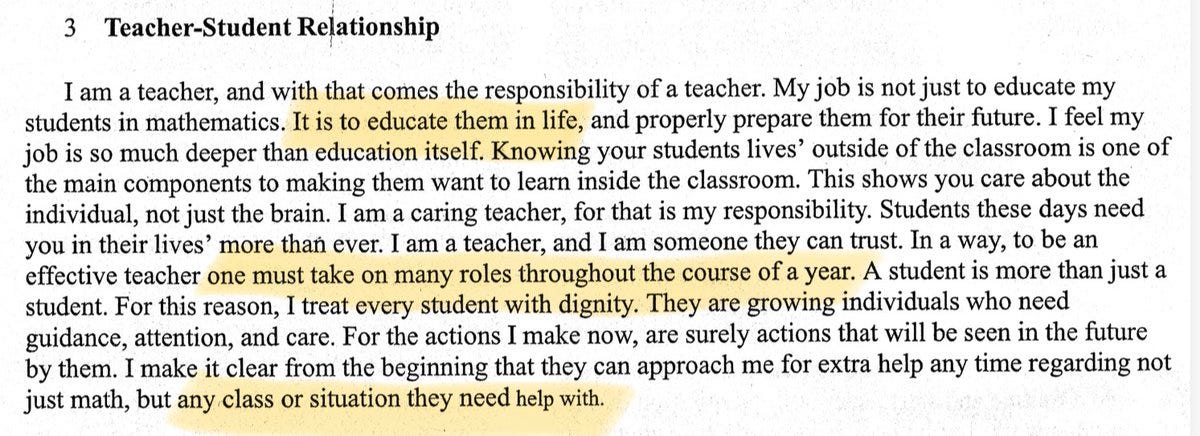
Teacher provided form
Educators hold an inherent evaluation authority over a student (grading, discipline, academic standing). The American School Counselor Association defines an attempt to hold dual roles (such as educator and mental health counselor) as a “dual-relationship conflict”. This relationship can cause harm as it introduces power imbalances and creates confusion surrounding privacy and trust.
Another risk this dual relationship poses is delayed intervention or misdiagnosis. A school counselor is uniquely trained to identify markers that require referral to parents or clinical practitioners. Conversations with untrained educators intended to treat “situations”, without the guidance of a trained professional, may interfere with the student’s ability to receive proper care.
Finally, the signature aspect of this scenario is crucial because it could allow the educator to evade accountability. I once taught at a high school where the principal had been removed for “non-sexual touching”. It was difficult to terminate him because the proper student-faculty relationship was poorly defined. Like any other occupation, relationships with those we work with, especially in positions of authority, and especially concerning minors, cannot be vague.
We can all agree that the teacher-student relationship is important. Kids learn more from teachers they trust. I sub for a good friend of mine who is often the only stable force in her student’s lives. Her students love and trust her, and she’s happy to listen when they have something to say. This is undoubtedly optimal. The difference is that she does not cosplay as a counselor, and does not require a parent signature to listen to her students.
Good educators want to help their students in any way they can. As a practitioner of I-O psychology, knowing when to refer a client to another practitioner is one of the most crucial skills we learn. Educators, like any practitioner, must approach their role with the understanding that they are not the parent, nor are they a counselor. They are educators.
And thank God for them.
This article was also posted to my X account: The Emerald Coast Consultant